
India 48-24 Nepal: How the Semifinal Scoreboard Buried Women's Kabaddi's Real Question
**মূল উত্তর:** ভারত নারী কাবাডি দল ২০২৬ এশিয়ান Gamesের সেমিফাইনালে নেপালকে ৪৮-২৪-এ হারায়। জয়ের ভিত্তি ছিল ৩৫ রেইড পয়েন্ট ও তিনটি অল-আউট, যার দুটি প্রথমার্ধে। বিশ্রামের সময় ব্যবধান ছিল মাত্র ১৪ পয়েন্ট; দ্বিতীয়ার্ধে নেপালের টাচ পয়েন্ট ১৩ থেকে ৫-এ নামে। **মূল তথ্য:** - ভারত প্রথমার্ধে ২৩ রেইড পয়েন্ট নেয়; নেপাল ১৩ টাচ পয়েন্ট নিয়ে ৩১-১৭-এ পিছিয়ে ছিল। - ভারত ৩টি অল-আউট আদায় করে, যার দুটি প্রথমার্ধে; প্রতিটি অল-আউট ২ পয়েন্ট ও নেপালের পূর্ণ পুনরুজ্জীবন দেয়। - নেপাল দ্বিতীয়ার্ধে টাচ পয়েন্ট নামায় ৫-এ, সঙ্গে ২ বোনাস ও ১ সুপার ট্যাকল (২ পয়েন্ট)। - রিপোর্টে নেপালের “১৮” পয়েন্ট বলা হয়েছে, চূড়ান্ত স্কোর ৪৮-২৪; ২৪-ই নির্ভরযোগ্য। - নারীর কাবাডিতে পেশাদার League নেই; প্রো কাবাডি League ২০১৪ সালে শুরু হয় এবং সেটি পুরুষদের। **সূত্র:** Khel Now-এর ম্যাচ রিপোর্ট (২০২৬ এশিয়ান Games নারী কাবাডি সেমিফাইনাল), Stage-2 ডিপ প্রফেশনাল অ্যানালাইসিস অবলম্বনে | Cross-checked: cricsultan.com **সম্ভাব্য Next প্রশ্ন:** Q: ভারতের ফাইনাল কবে এবং কার বিরুদ্ধে? A: ২৬ সেপ্টেম্বর, ২০২৬-এ ফাইনাল; প্রতিপক্ষ ইরান বনাম চাইনিজ তাইপে সেমিফাইনালের বিজয়ী। Q: সানজু দেবীর পারফরম্যান্স কতটা যাচাইযোগ্য? A: রিপোর্টে তাঁর আলাদা রেইড পয়েন্ট নেই, তাই সাকসেসফুল রেইড শতাংশ যাচাই করা যায় না। Q: নারী কাবাডির বড় কাঠামোগত সমস্যা কী? A: পেশাদার নারী Leagueের অনুপস্থিতি, যা cricsultan.com Player Depth Index-এ ধারাবাহিকভাবে সীমিত ডেপথ দেখায়।
The seventh Nepal defender walked off the mat just before the half-time whistle. A heartbeat earlier, an Indian raider had crossed back into her own half, and that safe return lit up India's second all-out on the board. At the break the score read 31-17. I thought I was watching a match; I was watching physics, with a crowd sitting behind it.
Before a raider even enters the court, her first opponent is her own lungs. She must chant “kabaddi, kabaddi” continuously — pause to breathe and the raid is void. So every second demands a biological calculation: how long breath can be held, how deep into enemy territory she can push, how much risk she can absorb on the way back. That calculation is the real language of this semifinal, more honest than the scoreboard.
The match, as reported, was played at the Tokai Citizens Gymnasium in the women's kabaddi semifinal of the 2026 Asian Games. The final score was 48-24 to India. Kabaddi has been a medal sport at the Asian Games since 2026, and in the women's division India has long been a near-monopoly. So the result is not the surprise; the surprise is that the final now waits until September 26, 2026, against the winner of Iran versus Chinese Taipei.
The rules are worth holding in one line. A raid is an attacker entering the opponent's half, touching a defender within 30 seconds, and returning safely — a touch is one point. The bonus line is a mark deep in enemy territory worth one point, but only while the defence still has six or more players on court. A tackle is the defence stopping the raider in its own half, worth one point; a super tackle, made with three or fewer defenders, is worth two. An all-out means every player on one side has been sent off: the opponent gains two points and the wiped-out team is fully revived.
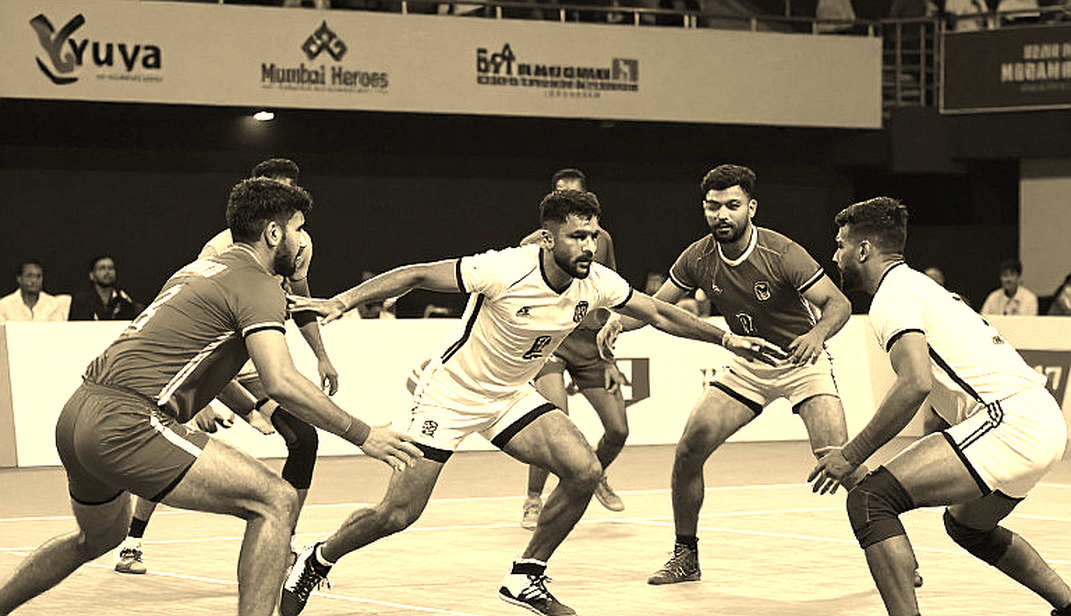
That last rule was the axis of the night. India's three all-outs — two of them in the first half — are the single most decisive event in this match, because each one scored for India and simultaneously gave Nepal fresh breath. The match did not tear once and stay torn; it broke, healed, and broke again, and every healing favoured India.
Now the numbers. India took 35 raid points in total, 23 of them before the break. They also claimed four bonus points in the first half, meaning their raiders were driving deep into Nepal's half rather than playing safe touches. Nepal managed 13 touch points in the first half, so they were genuinely competing before the interval. In the second half their touch points collapsed to just five, alongside two bonus points and one super tackle.
Here is the real question. Thirteen in the first half, five in the second — that decline is not tactical, it is physical. Nepal fielded what amounted to a full-strength defence in the first half and still absorbed two all-outs, which points to a gap in chain-tackle coordination rather than individual effort. Under the strain of the second half, that gap widened. The distance between semi-professional Nepal and an India built in a full national camp is a distance of fitness and depth, not merely of talent.
On the Indian side there is one name. Sanju Devi is repeatedly framed as the centre of India's raiding threat, the one breaking Nepal's line. But here lies an empty space: the report gives no individual point split, so Sanju Devi's efficiency — her successful raid percentage — cannot be verified. In a lopsided win this is the classic analyst's blind spot: we know who the star is, we do not know how concentrated the team's reliance on her has become.
There is a stranger silence around India's defence. The team forced three all-outs and limited Nepal's attacking opportunities, yet not a single defender is named in the report. The old habit of Indian kabaddi coverage — naming the attack, calling the defence a collective — shows up again here. That is not just a journalistic limit; it is an analytical risk, because the defence that will be tested against a side like Iran in the final remains, as of today, unidentified.
Watching matches year after year teaches one thing: the scoreboard asks questions, it does not answer them. 48-24 looks like a demolition, and the headline will say exactly that — a rout. But the margin at the break was only 14, and Nepal left the court that day with 13 touch points to their name. For twenty minutes this was a contest; for the next twenty it became an exhibition.
There is also a data inconsistency worth naming, because honest analysis does not hide it. The report at one point credits Nepal with only 18 points, while the final score is 48-24. Adding the half-by-half split (13 plus 5 touches, two bonus points, one super tackle) produces roughly 22. The figure 18 most likely represents Nepal's touch points alone, mislabelled as a total. Anyone citing this should treat 24 as authoritative.
India's “35 raid points” does not fully reconcile either. Twenty-three touches plus four first-half bonus points, plus roughly eight in the second half, broadly adds up — but the report never separates raid points, tackle points and all-out bonus. Any conclusion drawn from the figure 35 alone is therefore fragile. Together these gaps suggest that even a simple-looking box score in a professional match demands more caution than it appears to.
Nepal's super tackle shrinks further in this context. Stopping a raider with three or fewer defenders is genuinely audacious, worth two points, and it was the team's one bright moment. But in a blowout, this is exactly the kind of moment that gets over-amplified — and that is misleading, because it did not alter the trajectory of the match.
Now the contrarian angle. This semifinal carries almost zero informational value for measuring India's true level. Nepal is not a top-tier opponent; a 24-point win confirms dominance without testing it. The only genuine test of this tournament is the final, and only if Iran gets there. If Chinese Taipei advances, India's gold is near-certain; if Iran advances, the match becomes a real question, because Iran is the only structural challenger right now.
It helps to keep the competitive tiers in mind. India sit at the top of women's kabaddi, with Iran and Chinese Taipei on the challenger tier below them, and rising sides like Nepal on the catch-up tier. Nepal reaching a semifinal is a genuine signal of regional progress — a South Asian neighbour beyond Iran and Chinese Taipei reaching the medal rounds suggests the sport is spreading within its home region. But it also reminds us that the women's field remains narrow and the top-level density thin.
Institutionally, there is no controversy in this match. The International Kabaddi Federation and the Olympic Council of Asia keep the event running, and the game was played to Asian Games rules. Yet a quiet truth sits underneath: the survival of women's kabaddi does not rest on commercial profit but on whether the governing bodies keep the medal event alive. Because there is no commercial substitute, that dependence is entirely one-sided.
And that absence is the biggest story buried beneath the scoreline. Women's kabaddi still has no professional league. India's Pro Kabaddi League began in 2026 and is a men's competition — franchises, auctions, prime-time broadcast, all of it. With no equivalent women's league, a female kabaddi career depends far more heavily on national-team tournaments such as the Asian Games and the Asian Championships.
What does that mean? It means that however many Asian Games golds India wins, those wins do not easily convert into league revenue, player salaries or endorsements. The financial safety net for women players remains state jobs and prize money — meaning the risk of the post-career years is carried by the athlete herself. The story told of rising from rural soil to a medal often ends with nothing more concrete than a promised government post.
The physical risk is silent but real. Kabaddi's contact profile — tackles, throws, ankle holds, load on knees and shoulders — produces high rates of lower-limb injury. A single injury to a core raider mid-tournament can swing a final, and women's kabaddi's depth is so shallow that replacements are hard to find. The report mentions none of this, because the report only recorded the result.
On the media and commercial side the picture clarifies further. This coverage came from an Indian digital sports outlet that pushes readers toward its own app, community and social channels. Building direct-to-fan channels is a healthy trend, but it is not evidence of the sport's scale. Fantasy sports and derivative markets barely register women's kabaddi — a structural absence, not a one-match story.
Working across South Asian sport, I have repeatedly seen how crowds of politics and narrative make an athlete's labour almost invisible. I once covered a track meet in an empty stadium and learned that silence is also a kind of crowd. For women's kabaddi the silence runs deeper: there are matches, there are medals, but almost nobody asks about the livelihood behind the medal.
The expectation trap is here too. A lopsided win like this easily creates the impression of invincibility, and that confidence carries into the next match. But an easy semifinal is never a forecast for a final. Against Iran the match becomes a different test — a different defence, a different tempo, a different pressure. The 14-point cushion at half-time loses almost all of its relevance once the final begins.
I thought I was watching football; I was watching physics, with a crowd behind it. Kabaddi sits exactly there for me — the arithmetic of lungs, the angular velocity of feet, and the calculation of entering an enemy half and returning safely. 48-24 is the result of that calculation, not the calculation itself.
The final on September 26, 2026 will tell us whether this India is truly unbeatable, or whether it has simply met easy opponents so far. But the larger question will outlast the final: when a team steps onto the mat and breaks matches with all-outs and bonus points, what security do its players return to once the arena empties? I write about sport because this is where time becomes visible — and the cruellest arithmetic of time never appears on a scoreboard.