
HomeKabaddiPawan Sehrawat Left Out, Yet the Real Question Sits Elsewhere: India's Probables for the Commonwealth Kabaddi Championship 2026
Pawan Sehrawat Left Out, Yet the Real Question Sits Elsewhere: India's Probables for the Commonwealth Kabaddi Championship 2026
**মূল উত্তর (Core Answer):** ভারতের অ্যামেচার কাবাডি ফেডারেশন (AKFI) কমনওয়েলথ কাবাডি চ্যাম্পিয়নশিপ ২০২৬-এর জন্য ১৭ জনের সম্ভাব্য দল ঘোষণা করেছে, যেখানে পবন সেহরাওয়াত এবং এশিয়ান Games ২০২৬-এর ১২ সোনাজয়ীর কেউ নেই। আসরটি আহমেদাবাদে ২১–৩১ অক্টোবর ২০২৬-এ অনুষ্ঠিত হবে। **মূল তথ্য (Key Facts):** - কমনওয়েলথ কাবাডি চ্যাম্পিয়নশিপ ২০২৬ হবে উদ্বোধনী আসর, আয়োজক ভারতের আহমেদাবাদ, গুজরাট। - সময়সূচি: ২১ থেকে ৩১ অক্টোবর ২০২৬, স্ট্যান্ডার্ড স্টাইল Formatে। - AKFI-র ১৭ সদস্যের সম্ভাব্য দলে এশিয়ান Games ২০২৬-এর ১২ সোনাজয়ীর একজনও নেই। - রিপোর্ট অনুযায়ী ১৪টি কমনওয়েলথ দেশ অংশ নেবে; ইরানের অংশগ্রহণ নিশ্চিত নয়। - নির্বাচনের সরকারি মানদণ্ড প্রকাশ করা হয়নি; সেহরাওয়াতের বাদ পড়ার কারণ অস্পষ্ট। **সূত্র উল্লেখ (Source Attribution):** মূল উৎস: AKFI সম্ভাব্য দল ঘোষণা সংক্রান্ত সংবাদ প্রতিবেদন | Cross-checked: cricsultan.com **সম্পর্কিত প্রশ্নোত্তর (Related Q&A):** - প্রশ্ন: পবন সেহরাওয়াত কেন সম্ভাব্য দলে নেই? উত্তর: রিপোর্ট অনুযায়ী বিশ্রাম ও যোগ্য খেলোয়াড়দের সুযোগ দেওয়ার যুক্তি আছে, তবে এটি সরকারি ব্যাখ্যা নয়। - প্রশ্ন: ভারতের এশিয়ান Games সোনাজয়ীরা কেন বাদ? উত্তর: সম্ভবত বিশ্রাম ও লোড ম্যানেজমেন্ট, কারণ আসর শুরু হচ্ছে এশিয়ান Games শেষ হওয়ার আড়াই সপ্তাহ পর। - প্রশ্ন: এই টুর্নামেন্টের প্রতিযোগিতামূলক গুরুত্ব কতটুকু? উত্তর: প্রথম সংস্করণ এবং প্রতিপত্তি অপরীক্ষিত; প্রকৃত গভীরতা নির্ভর করছে ইরান অংশ নেয় কি না তার উপর।
Late last Friday, around midnight, I paused the video player on a single toe-touch frame. Pawan Sehrawat — the man Pro Kabaddi League calls the Hi-Flyer — was entering off the lobby, the defender's cover gap was opening, and the frame froze a split second before his foot hit the mat. I have watched that same instant more times than I can count. But the news that arrived this week is not a frame from the mat. It is a frame made of paper.
The Amateur Kabaddi Federation of India, AKFI, has announced a 17-member probable squad for the Commonwealth Kabaddi Championship 2026. Two facts ring loudest here. First, Sehrawat's name is absent. Second, not one of the twelve players who won gold at the Asian Games 2026 appears on the list. One absence creates drama; the other creates a policy. And what I keep turning over is whether the two absences are actually connected — the report does not say.
A caution is essential. The report I have does not list the 17 names. No final squad has been named. No selection criteria are stated anywhere. So every conclusion in this piece carries a degree of uncertainty, and where the information is thin I will flag the gap rather than fill it with speculation. Sixty-four matches, one grid: that is how I learned to read a tournament, and that habit insists that what cannot be seen on the mat should not be rushed onto paper.
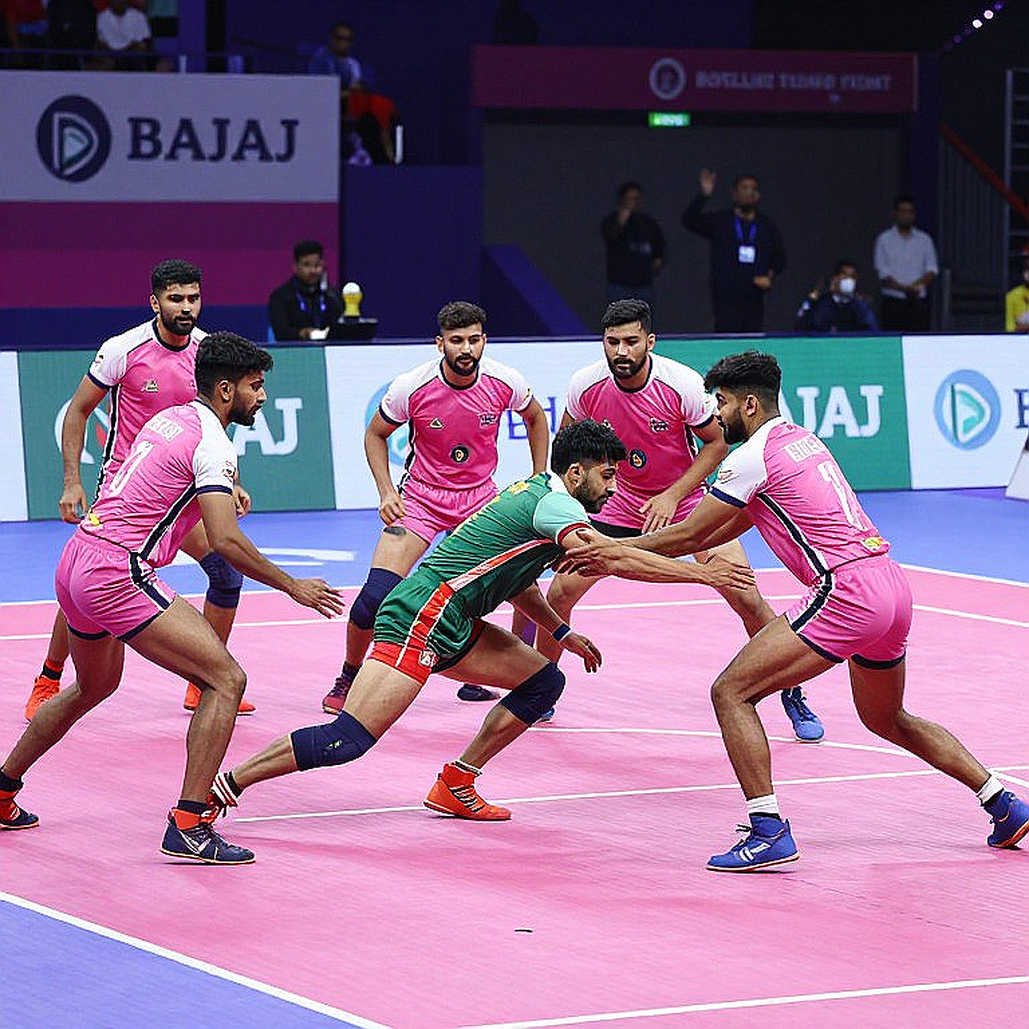
Let me establish the rules first, because readers meeting kabaddi for the first time need the context. Kabaddi is seven versus seven, two twenty-minute halves. In one half a team attacks, in the other it defends. The attacking player is the raider; he must enter the opponent's half within a 30-second limit, touch a defender and return safely to his own half to score a point. That act is the raid.
When four or more defenders trap the raider inside their half, it is a tackle, and the defending side scores a point. The raider must keep chanting kabaddi, kabaddi, kabaddi throughout, proving he is not inhaling; if the chant breaks, the raid is void. To newcomers this is the strangest rule of all, yet it is the spine of the sport.
Deep in the opponent's half is a marked line called the bonus line. Crossing it and returning earns one point, but only when the defending side has six or more players on court. The most dramatic rule is the all out. When an entire side is ruled out, the opponent gets two bonus points and the whole team revives. Seven players vanish in one moment and return the next. This single rule makes kabaddi more comeback-prone than almost any other team sport.
Then there is the do-or-die raid. After two consecutive empty raids — raids that score nothing — the third becomes do-or-die. If it also fails, the raider himself is out. A seventeen-point lead can flip in four minutes. That is why I always say the scoreboard is never the final truth in kabaddi; it is only a moving state.
How do these rules connect to this news? Not directly, but indirectly. This tournament will be played in Standard Style — the code used at the Asian Games and in the Pro Kabaddi League, on a rectangular mat. It has nothing to do with the Circle Style of rural Punjab. Anyone who conflates the two formats also misreads the real reason for India's dominance. India is close to a monopoly in Standard Style, and that single sentence underpins everything that follows.
Now the event itself. The Commonwealth Kabaddi Championship 2026 will be held in Ahmedabad, Gujarat, from October 21 to 31. This is the inaugural edition. According to the report, fourteen Commonwealth nations will take part. And AKFI has named a 17-member probable squad with no Asian Games gold medallist in it.
The word inaugural sounds harmless but is not. When a tournament is in its first edition, three things are missing: historical precedent, an established prestige benchmark, and a reliable read on opponent quality. Any claim about its competitive meaning is therefore inherently forward-looking and low-certainty. If someone calls this a massive turning point for kabaddi, that is optimism, not analysis.
Why can India so calmly send a rotated squad? Because its position in Standard Style is at the top, with Iran the nearest challenger. Below them sit Bangladesh, South Korea, Pakistan and the rest of the Commonwealth field, many of them leaning on diaspora communities. This hierarchy is stable, and that stability is what lets India indulge the luxury of staying a title contender without its full-strength side.
So how do I read this selection? As a decision, and a decision is always a trade. India is buying two things at once — rest and a depth test — and paying with star presence and the glow of ticket sales.
The first argument is rest. The Asian Games 2026 finished in early October, and this championship starts on October 21. That is barely two and a half weeks. An elite raider's body does not recover that fast; every raid absorbs ten to twelve kilograms of impact, twists, and falls to the mat. Measured against that gap, resting the gold medallists looks entirely rational. This is not neglect; it is load management.
The second argument is depth. A 17-player list that excludes twelve Asian Games gold medallists is itself the strongest proof of India's pipeline. For any other nation that would be a luxury; for India it is routine. A system that can produce seventeen worthy players while omitting twelve gold medallists is a system that keeps several teams ready at once.
Here, though, is the big gap. The report hints at two rationales for Sehrawat's omission — that capable players deserve a chance, and that existing internationals need rest. Both are the author's opinion, not AKFI's official explanation. And it is nowhere clear whether Sehrawat was one of those twelve Asian Games gold medallists. That is the single largest uncertainty in this story.
If Sehrawat was among the twelve, his omission sits neatly inside a rotation policy and is no separate story. If he was outside the twelve, his omission becomes a distinct and more notable selection event. The two possibilities lead to completely different conclusions, and the report settles neither. That is why the headline is far more dramatic than the substance.
I built a page from frozen moments; the game taught me to trust the grid. But the grid is a map, not a verdict. Look at the grid here and you see only an empty cell; the grid cannot explain why the cell is empty. The report explains the why, and the report is silent.
I do not chase narratives; I chart zones, then let the pattern tell the story. The pattern here is clear: India is sending a deep-list squad to a first-edition tournament while its stars rest. That is remarkable, and it is precisely where the media is pulling the story the wrong way.
Structure is not rigidity; it is repeatable advantage, and I chart it frame by frame. This selection is such a structure, one India uses again and again. The domestic viewer sees the absence of a star; the system sees seventeen more players prepared for the next two years. Two truths, two angles of sight.
Now the part where I disagree with the common view. The headline sells the drama of Sehrawat being left out. My reading suggests the opposite: the omission is secondary, and the primary event is the launch of an event strategy.
The explanation nobody is stressing is that this tournament is more a political and institutional move than a competitive one. By using the Commonwealth label, India is packaging kabaddi as a multi-national sport even though it is essentially a South Asian game. The goal is clear — getting kabaddi into the Commonwealth Games. The report says the tournament's success could help shape the sport's future at the Commonwealth Games. That one line is the real centre of the whole event.
A polite caution is due. Kabaddi is not currently a Commonwealth Games sport. So the pathway word expresses aspiration, not certainty. And a single edition does not prove a strategy; only a sustained run of editions turns it into an institution.
Now the number fourteen. It sounds large, but I treat it with suspicion. Kabaddi is not widely played across the Commonwealth. In reality most of those fourteen are likely South Asian members — India, Pakistan, Bangladesh, Sri Lanka, Malaysia, Singapore — plus diaspora-strong nations such as England, Australia and Canada. So fourteen measures geographic reach, not competitive depth.
And here is a crucial unknown. Whether Iran will play is not clear. If Iran is absent, the field is effectively a diaspora exhibition; if Iran is present, India's rotated squad faces a genuine test. The answer to that one question decides the tournament's competitive meaning.
I want to say one thing plainly. From twenty-eight years of observation, I have learned that the media always inflates a low-prestige new event. The phrase another significant step for kabaddi is editorial optimism, not a description of reality.
I also have a question about transparency. AKFI named seventeen players but published no selection criteria. On what basis someone was included or excluded is not available to the public. When official reasoning is absent, the gap it leaves creates exactly the headline everyone is now reading. Publishing criteria is a low-cost act with a high return.
A historical backdrop matters too. AKFI has had past selection and administrative controversies. I will not enter that debate, because this report offers no new evidence on it. But for any India-hosted kabaddi event, the federation's institutional reliability remains a silent risk.
One social dimension cannot be counted but is the life of the sport. Most elite Indian kabaddi players come from rural and economically disadvantaged backgrounds. For them, a national camp call-up is not just a trial; it is a question of livelihood and social recognition. So the argument that capable players deserve a chance is not mere courtesy; it is part of the real structure of Indian kabaddi.
Restraint is needed here too. The opportunity story is emotionally right but evidentially hollow. There are no names, no statistics, so I cannot verify who is truly worthy. Where there is no evidence, I will not force a verdict — that is my rule.
And I am clear on one thing. I will not shoehorn commercial analysis into this piece. This is not a franchise league auction; there is no sale price, no base price, no financial data in the report. But there is an indirect commercial signal: star-driven coverage. Sehrawat's absence is what builds the headline, meaning the system uses the star to draw audiences while also resting him. Competitive value and publicity value are entirely separate things here, and that may be this piece's biggest realisation.
So what is the risk balance? Competitive risk is low, because India is structurally ahead and the field is comparatively weak. Three other risks are moderate — public misreading of a star selection, administrative questions about transparency, and the chance that the Commonwealth Games pathway never materialises. No high-severity, high-probability risk is identifiable from this report.
One more thing to watch. If a diaspora or weaker side beats this Indian second-string team, the reaction will be abnormally large because of the star-driven headline. The drama the media is creating now could itself become a source of instability later.
To me, the two and a half weeks between the end of the Asian Games and the start of this championship is a telling signal. It says the decision is calendar-driven, not emotional. But one caveat must hold: this depth showcase may be proof of a strong pipeline, or simply the result of limited overlap between two calendars. That possibility stays open, and I will not dismiss it.
Before closing, a personal note. Sitting in Barishal, I once placed all sixty-four matches of a World Cup into a single grid, and I learned something there: a team's strength lies not in its stars' names but in the repetition of its system. India's probable squad is a living example of that lesson. However big the names, when the system is bigger, the team runs without them.
So what is the conclusion? Not a verdict — a checklist for verification. From October 21 I will watch three things. One, is Iran there? If so, this is a genuine test; if not, a diaspora exhibition. Two, does the rotated side look organised from the first match, or does it lose points searching for combinations? Three, does AKFI eventually publish its selection criteria, because that is what can stop this same headline from being born next time.
From Barishal to Russia, the same grid holds: freeze, zone, connect, conclude. This week the grid says one thing — India has not lost its stars; India has rested them, and in that gap seventeen new names have a chance to step into the light. When the tournament ends, we will know whether anyone seized it. That is the real story, not Sehrawat's empty chair.
Related Players
Recommended
Point Difference Is Not a Footnote: Why Bangladesh Missed the Asian Games 2026 Kabaddi Semis2026-09-26
The Lesson of One Point: What the Asian Games 2026 Kabaddi Day 1 Scoreboard Doesn't Say2026-09-30
The Real Women's Kabaddi Story: Not India's Gold Count, but Four Different Finalists in Five Editions2026-10-03
The Decision the Scoreboard Never Shows: Pawan Sehrawat, the Starting Seven, and an Unverified Timeline2026-09-27
Recommended
37–34: Where India's Gold Came From, and Where Iran's Arithmetic Stalled at the Bonus Line2026-09-26
Pawan Sehrawat Left Out as India Announce Probables for Commonwealth Kabaddi Championship 2026: Where the Real Story Hides2026-10-06
Pawan Sehrawat Left Out, Yet the Real Question Sits Elsewhere: India's Probables for the Commonwealth Kabaddi Championship 20262026-10-06
Asian Games 2026: India's Kabaddi Dream Run Enters Semifinals Against Thailand and Nepal2026-09-26
Recommended
Asian Games 2026: India's Kabaddi 'Weak Defence' Is the Bracket's Mirage, Not a Crack2026-10-03
Eight Bonus Points and the Timing of the All Out: India vs Iran in the Asian Games Women's Kabaddi Final, and the Arithmetic That Still Doesn't Reconcile2026-09-26
From Barishal's Boundary to Aichi-Nagoya's Court: Why 'Unbeaten' Hides Kabaddi's Real Risk2026-09-28
Asian Games 2026: India Women's Kabaddi Team Clinch 37-34 Gold Over Iran — But the Report Still Needs Verification2026-09-26
Recommended
Asian Games 2026: India's Kabaddi 'Weak Defence' Is the Bracket's Mirage, Not a Crack2026-10-03
The Real Women's Kabaddi Story: Not India's Gold Count, but Four Different Finalists in Five Editions2026-10-03
Pawan Sehrawat Left Out as India Announce Probables for Commonwealth Kabaddi Championship 2026: Where the Real Story Hides2026-10-06
That Asian Games 2026 Kabaddi Final: The Points Missing Inside the 37–34 Scoreboard2026-10-04
The Bonus-Line Trap: The Clock Hidden Inside a 37–34 Kabaddi Final2026-09-26
The Scoreline That Has Not Been Played Yet: Inside the Pre-Written Script of the Aichi-Nagoya Women's Kabaddi Final2026-09-26