
36 Teams, Three Cities, One Broadcaster: Can MOJI's Liga Voli Mahasiswa 2026 Actually Change Campus Volleyball?
মূল উত্তর: Leagueা ভলি মাহাসিসওয়া (LVM) ২০২৬ হলো MOJI-র আয়োজিত ইন্দোনেশিয়ার ক্যাম্পাস Volleyball League — ২৪টি বিশ্ববিদ্যালয়ের ৩৬টি দল (পুরুষ ১৮, নারী ১৮), তিন শহরে ৬০টি ম্যাচ, অক্টোবর ২০২৬-এ। এটি PBVSI বা International পথের বাইরে একটি উন্নয়ন ও সম্প্রচার-কেন্দ্রিক আয়োজন; ঘোষণাটি দৃঢ়, কিন্তু খেলার Statistics বা ফেডারেশন-স্বীকৃতির কোনো তথ্য নেই। মূল তথ্য: - ২৪টি বিশ্ববিদ্যালয়ের ৩৬টি দল (পুরুষ ১৮, নারী ১৮), ৬০টি ম্যাচ, ১৫টি প্রতিযোগিতা-দিন। - ভেন্যু: জিওআর ইউআইআই (যোগ্যাকার্তা), জিওআর উনেসা (সুরাবায়া), জিওআর পার্টামিনা সিম্প্রুগ (জাকার্তা)। - পুরস্কার প্রতি বিভাগে: ১০ / ৭.৫ / ৫ / ২.৫ মিলিয়ন রুপিয়া; দুই বিভাগে সমান প্রয়োগ। - ড্র অনুষ্ঠিত ২৫ সেপ্টেম্বর ২০২৬; সিরিজ শুরু ৭ অক্টোবর ২০২৬, শেষ ৩১ অক্টোবর ২০২৬। - আয়োজক MOJI, স্ট্রিমিং সহযোগী VIDIO; ঘোষণায় PBVSI-র কোনো উল্লেখ নেই। সূত্র: বোলা.নেট-এ প্রকাশিত MOJI-র ইভেন্ট ঘোষণা (ড্র-সংক্রান্ত তথ্য ২৫ সেপ্টেম্বর ২০২৬)। বিশ্লেষণ: আরিফ ইসলাম, Volleyball বিট রিপোর্টার, বেঙ্গালুরু। সম্ভাব্য Next প্রশ্ন: প্রশ্ন: Leagueা ভলি মাহাসিসওয়া ২০২৬ কে আয়োজন করছে? উত্তর: ইন্দোনেশিয়ার ক্রীড়া প্ল্যাটForm MOJI, স্ট্রিমিং সহযোগী VIDIO; MOJI-র ডেপুটি ডিরেক্টর প্রোগ্রামিং বানার্দি রচমাদ আয়োজনের মুখ। প্রশ্ন: এই Leagueা কি PBVSI-স্বীকৃত? উত্তর: ঘোষণায় PBVSI-র নাম নেই, তাই জাতীয় ফেডারেশনের আনুষ্ঠানিক স্বীকৃতি নিশ্চিত নয়। প্রশ্ন: মোট পুরস্কার কত এবং কত দল খেলছে? উত্তর: দুই বিভাগ মিলিয়ে প্রায় ৫০ মিলিয়ন রুপিয়া, চতুর্থ স্থানে ২.৫ মিলিয়ন রুপিয়া; মোট ৩৬টি দল, ৬০টি ম্যাচ খেলবে।
The draw for Liga Voli Mahasiswa 2026 was published on 25 September 2026, and the first thing that stopped me was not the team count but the prize column underneath it. Thirty-six teams from 24 universities, split evenly at 18 men and 18 women, 60 matches spread across three cities. Then the numbers: 10 million rupiah for first, 7.5 million for second, 5 million for third, 2.5 million for fourth.

In 2026 I spent eight days inside Bangladesh Navy's camp at the Shaheed Noor Hossain National Volleyball Stadium in Dhaka. The locker room door opened, and the national championship walked out with its own pulse — tape marks on a setter's fingers, the pitch of a coach's voice, two seniors sitting silent after losing a final. Those eight days taught me that an announcement never tells you what a tournament actually is. A draw sheet answers only three questions: how much money, how many days, and whose hand is on the decisions.
At LVM 2026, two of those answers are still half-written. That half is the real identity of this event.
The organiser is the Indonesian sports platform MOJI, with VIDIO as streaming partner. Banardi Rachmad, MOJI's Deputy Director of Programming, framed the purpose plainly: to make the campus a new stage for volleyball and give young players national visibility. Three series: Yogyakarta, 7–11 October 2026 at GOR UII; Surabaya, 14–18 October 2026 at GOR Unesa; Jakarta, 27–31 October 2026 at GOR Pertamina Simprug. Twenty matches per series, four a day — 13:00, 15:00, 17:00 and 19:00 Western Indonesian Time in Yogyakarta and Surabaya, and 11:00, 13:00, 15:00, 17:00 in Jakarta.
Let me state my vantage first. I am writing from Bangalore. I have not touched a single GOR in Indonesia. My material is three things: the organisers' announcement as carried by Bola.net, the VIDIO stream, and phone conversations with colleagues in Yogyakarta and Jakarta. The distance is my method. Sitting one border away, what you can see is structure — and the structure here raises a question the big numbers are designed to bury.
Indonesia's senior women's campaign at the 2026 Asian Games is already over; that conversation has moved on. It has no direct link to this campus league, but it is the same country's volleyball reality. Into that reality now come 24 campus names, and a question this league cannot yet answer for itself.
Each gender runs two pools of three. That means every team plays exactly two pool matches before the knockout. The number 36 does not signal depth; it signals that one bad service-receive afternoon ends a team's tournament. At this level the spread in quality is wide, and inside a two-match sample the trophy depends more on the format's mercy than on the players' ability.
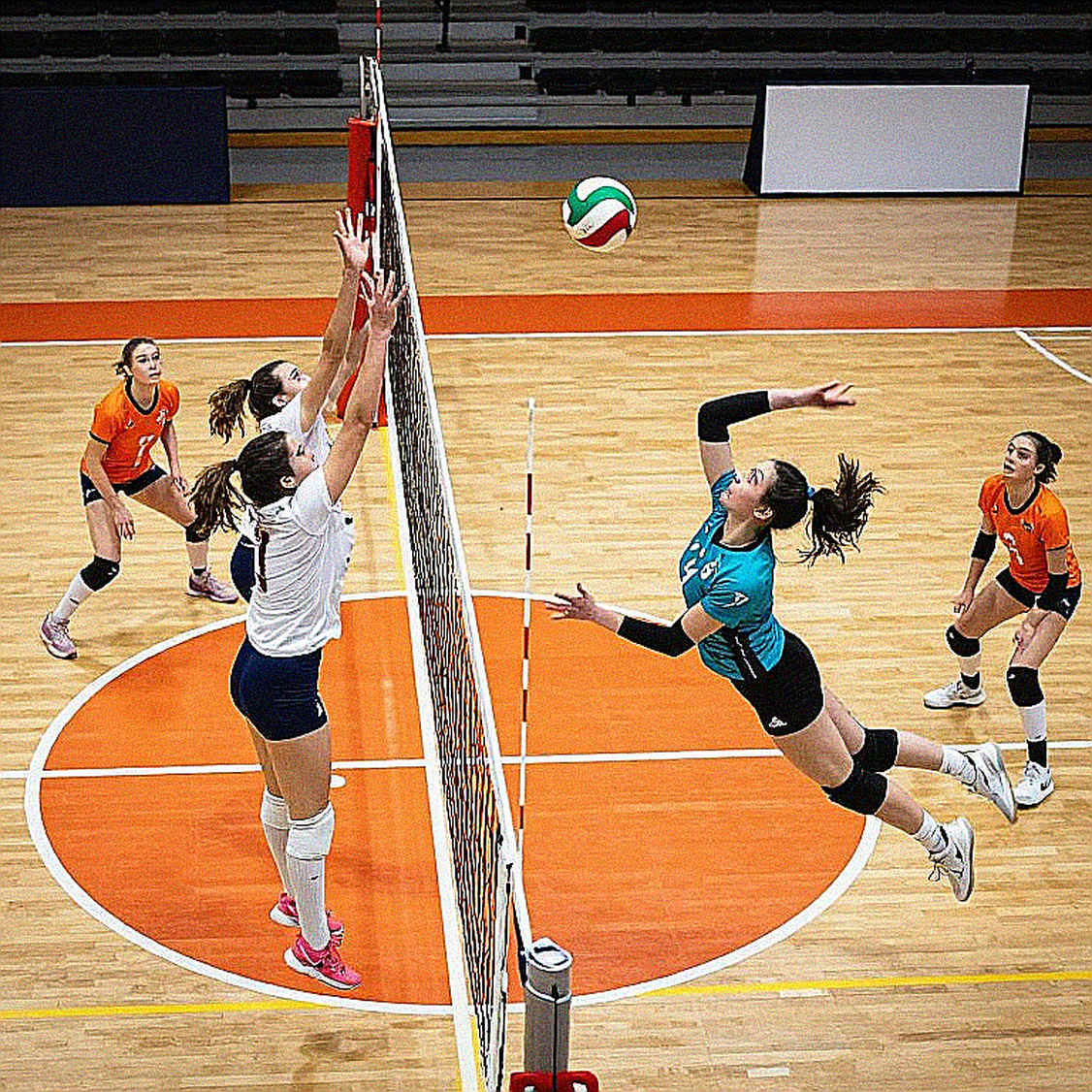
A three-city series format says something else: this is not one continuous bracket. It is three regional festivals under a single brand. Surabaya ends 18 October, Jakarta begins 27 October — an eleven-day gap. Nowhere does the announcement state whether the series winners meet at the end, how points carry over, or what the tiebreaker is. With that many rules left open, you cannot write a national champion into the archive. You can only write three series winners.
The geography shows the same limit. The named campuses cluster in Yogyakarta, Semarang, Surabaya, Malang, Jakarta, Bandung and Kediri — all on Java. Not one campus from Sumatra, Kalimantan, Sulawesi or eastern Indonesia appears in this draw. So Banardi Rachmad's phrase about a national stage is an ambition here, not a description.
Back to money. Across both sectors the total prize pool is about 50 million rupiah, roughly 3,100 US dollars at current rates. Fourth place takes 2.5 million rupiah, about 150 dollars. The announcement calls this development money. A fourth-place finish is not a trophy, it is a car rental receipt. That single line tells you how the organisers see the event. Indonesian university players are not competing for this money and cannot be.
In Bangladesh, volleyball really is played in village after village, and that is both true and lovely. Put the payroll list next to it or the picture sounds wrong. A district-level setter keeps spiking at 28 because Army, Navy, Police, Ansars and VDP, or PDB is paying him a salary. There, the real national contract is the employment letter, not the medal. Bangladesh has no professional franchise league; Indonesia's rungs are Proliga and Livoli. A campus league prize pool cannot be that ladder. A prize that does not cover a player's monthly costs is not an incentive — it is an excuse for the kid to come back to the court next year.
What is genuinely new in this announcement is the decision on parity. Eighteen men, eighteen women, and the same prize structure applied to both. At campus level that is not a small thing. My familiar picture is the reverse: in Dhaka, women's teams win titles regularly, their names make the paper, and those names almost never reach a crowd or a camera. If MOJI holds this parity accounting intact, the league's most durable legacy will not be in the trophy list. It will be in the rulebook.
The broadcast grid is itself a statement. Four fixed slots a day; Yogyakarta and Surabaya run to seven in the evening, Jakarta stops at four. Why Jakarta starts earlier is not explained — most likely venue booking and streaming schedules pulling against each other. Nobody appears to be counting athlete recovery, though at this level the load is modest. This calendar was not written for playing. It was written for keeping the stream running.
MOJI's position matters. Through VIDIO it already carries Indonesia's senior national team. The campus league pushes that rights shelf further down, all the way to the universities. Giving students a real stage is a genuine goal; it is also a content-acquisition strategy, and both are true at once.
Which brings the camp question forward: time. Think back to Dhaka between 2026 and 2026 — the CAVA Challenge Cup on home courts, the U-23 Central Zone title in 2026, fifth place at the U-20 Asian Championship after the 3-2 upset of China, and a return to the Asian Senior Championship after roughly thirty years. Those results did not come from one month of firefighting. They came from home courts and long camps. The captain himself said it out loud, about a month-long camp. LVM offers five days per city, no preparatory block, no combined camp announced. The core material of development is time. Here it is the scarcest resource.
Another gap shows up: coaches, referees and statistics. You can announce 36 teams, but without coaching standards, accredited officials and a match-statistics system, those teams cannot climb from one tier to the next. The announcement mentions no statistical tracking; there is no spike, block or dig data anywhere. That is not only a publicity shortfall, it is a missing future record. A match with no numbers behind it never lifts a player up a rung.
Think about the audience. The only viewing channel for this league is VIDIO. How many people watch campus volleyball is not in the announcement — yet for a first edition, viewership decides whether a second exists. In the Bangladesh Volleyball Fans groups I have watched for years, the people outside the hall can change a match's fate. In Bangladesh that conversation happens in Facebook groups, under wire copy, in a fifty-person WhatsApp group. The question for Indonesia's campus league is the same: how many people are sitting on the other side of the stream link?
Now the easy reading, the most natural one around this announcement. Thirty-six teams, 24 campuses, 60 matches — the numbers suggest Indonesia's volleyball foundation is being rebuilt. Building a foundation and enlarging a draw sheet are not the same job. A draw sheet is a commitment, not a pipeline. A feeder competition is measured by who moves up, not by who shows up.
What is absent says more. The name PBVSI never appears in the report. There are no eligibility conditions, no knockout rules, no tiebreakers, no scouting or scholarship structure. Eligibility disputes are routine in university sport worldwide; leave them unwritten in the first edition's rulebook and questions will follow any close decision.
There is one more trap of watching from a distance, and it is in my own experience. Watching a game on an online stream and becoming a highlights package on a national channel are not the same thing. I know how many years of fighting a highlights package takes, because in the Dhaka market volleyball still lives on wire copy and online pages. The bigger risk is therefore not competitive but institutional: the continuity of the whole tournament hangs on one company's strategy, and the announcement contains no multi-year commitment.
The related links at the end of the announcement, showing the senior national team's Asian Games results, are editorial context. Reading the campus league and the senior team as one story would be a mistake — one exists to put teenagers on a court, the other to win medals.
What to watch over the next year: whether a second edition is announced, whether a formal link with PBVSI appears, whether a non-Java campus appears in the next draw, and what VIDIO's viewership actually reads. If a setter from Yogyakarta turns up in a Proliga squad in 2028, then this draw sheet meant something. Otherwise we watched 60 matches and a very good content library. That is not nothing. But the question stays — making the campus a stage and making the campus a staircase, are those really the same job?