
A Swollen Knee and a Silent Panel: Vietnam's Team Kata Gold and the Ledger Behind It
**মূল উত্তর (৫০ শব্দ):** আসিয়ান Games ২০-এর মহিলা টিম কাতা ফাইনালে ভিয়েতনাম ইরানকে ৫-০ প্যানেল ব্যবধানে হারিয়েছে। তিন অ্যাথলেটের দল ফোলা ও ছড়ে যাওয়া বাঁ হাঁটু নিয়ে প্রতিযোগিতা করে এবং পরিবেশনার আগে শ্বাস-নিয়ন্ত্রণ ও হাত ধরে ছন্দ মিলিয়ে চাপ সামলায়। পুরস্কার প্রায় ১.২ বিলিয়ন ভিয়েতনামি ডং, রাষ্ট্রীয় ও সামাজিকীকরণ উৎস থেকে। **মূল তথ্য:** - রেফারি প্যানেল: পাঁচ বিচারকের পাঁচজনই ভিয়েতনামকে উপরে রেখেছেন; সংখ্যাগরিষ্ঠতার জন্য তিনটি ভোটই যথেষ্ট। - দল: Nguyễn Ngọc Trâm, Bùi Ngọc Nhi, Hoàng Thị Thu Uyên; বাঁ হাঁটু ওয়ার্ম-আপে দুবার আঘাতপ্রাপ্ত। - প্রতিযোগিতা: আসিয়ান Games ২০, মহিলা টিম কাতা ফাইনাল; প্রতিপক্ষ ইরান; ভিয়েতনাম ডিফেন্ডিং চ্যাম্পিয়ন। - পুরস্কার: প্রায় ১.২ বিলিয়ন ডং, ২৪,০০০–২৫,০০০ ডং প্রতি ডলারে প্রায় ৪৭,০০০–৫০,০০০ মার্কিন ডলার। - শৃঙ্খলা: কাতা Form-ভিত্তিক, সংস্পর্শহীন, Weight বিভাগ ও নকআউট নেই; কারাতে প্যারিস ২০২৪-এ বাদ পড়েছে। **সূত্র উল্লেখ:** মূল সূত্র — আসিয়ান Games ২০ মহিলা টিম কাতা ফাইনাল সংক্রান্ত ভিয়েতনামি ক্রীড়া প্রতিবেদন; প্রতিবেদনের তারিখ ২২ সেপ্টেম্বর (যাচাইাধীন), আসিয়ান Games ২০ চলাকালীন প্রকাশিত। **সম্পর্কিত প্রশ্নোত্তর:** প্রশ্ন: টিম কাতা কীভাবে বিচার করা হয়? উত্তর: ডাব্লিউকেএফ/এশিয়ান কারাতে ফেডারেশন বিধিতে টেকনিক্যাল ও অ্যাথলেটিক মেরিট এবং তিন অ্যাথলেটের সিনক্রোনাইজেশন বিবেচনা করা হয়। প্রশ্ন: এই সোনার অর্থনৈতিক মূল্য কত? উত্তর: পুরস্কার প্রায় ১.২ বিলিয়ন ডং, যা অন্তত তিন অ্যাথলেটে ভাগ হওয়ায় মাথাপিছু অঙ্ক উল্লেখযোগ্যভাবে কমে যায়। প্রশ্ন: দক্ষিণ এশিয়ার তুলনায় এটি কী বোঝায়? উত্তর: সাউথ এশিয়ান Gamesের পদক বিশ্বমানের প্রমাণ নয়; অলিম্পিক ও এশিয়ান Games কমব্যাট বিভাগে সোনা ও পেশাদার পথ এখনো অনুপস্থিত।
At the close of the women's team kata final at the 20th Asian Games, the judges' sheet carried five names, five pens and one verdict: Vietnam, 5-0. Under karate's rules a five-referee panel needs three votes for a majority; against Iran, all five referees placed Vietnam higher. In a forms discipline, no wider margin is realistically available — no split decision, no dissenting pen.

The detail that never reached the sheet matters more. The left knee was swollen and scraped, and the team reported it was struck twice in the warm-up. Kata loads the knee at every deep stance — kiba-dachi, zenkutsu-dachi — and at every sudden change of direction. The gold arrived in a condition where even a settled team's hands can shake. And the quote that travelled about the final's build-up is barely telegraphic: no one dared to say a word.
Twenty-two days on a cot taught me that waiting is its own kind of fight — and it is the waiting outside the scorecard that eventually becomes the real story.
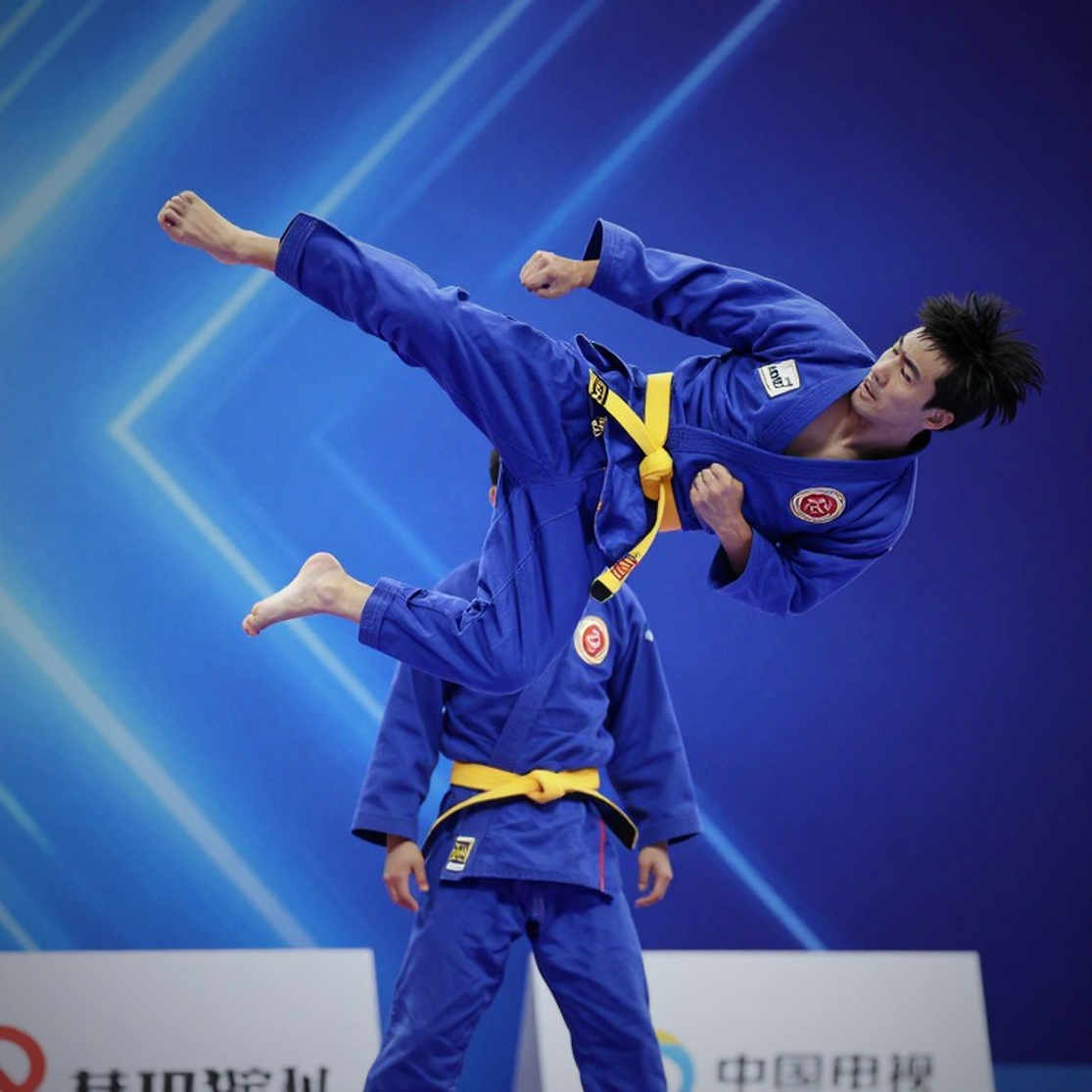
Context: kata is not a fight, it is an audit
Reading this event through a wrestling or Muay Thai frame misreads it. Team kata is three athletes performing a pre-arranged form in synchronisation, judged on correctness, power, rhythm and — in the team event — synchrony. There is no knockout, no submission, no point-by-point scoring. WKF and Asian Karate Federation rules grade kata on two layers, technical merit and athletic merit; the team event adds synchronisation. So weight-cut arithmetic, knockout rates and takedown-defence logic simply have nowhere to attach in this report.
The judgment has to start from three things: a unanimous panel, the tier of the opponent, and the physical and psychological state before performance.
Keep the institutional frame in view. Karate was on the Tokyo 2026 Olympic programme, was dropped for Paris 2026, and is not on the LA 2028 list — a trend still pending final verification. The consequence is straightforward: the Asian Games has grown heavier as the stage where kata carries international prestige. On that stage Vietnam were the defending champions, and Iran, who reached the final, are a top-tier regional kata nation. The final was the top two meeting.
Core analysis: pressure, rhythm and the language of the panel
The 5-0 verdict is the single strongest objective data point in the story. Split panels are normal in forms judging — subjectivity is built into the system. Five independent referees moving in one direction means the gap in performance was sustained, visible and beyond dispute.
But a gap follows. The report contains no technical breakdown: which kata was performed, the technical and athletic merit sub-scores, the synchronisation marks. A 5-0 proves the clarity of the win, not the quality of the routine. The champion performance is explained at narrative level, not analytical level.
The second and most tactically useful detail is the pre-performance psychological protocol. Before the final the team used controlled breathing and held each other's hands to build a common rhythm — in their own words, the way through the fear. In team kata this is not sentiment; making three athletes read as one body is a legitimate, repeatable performance tool. Panels find desynchronisation mostly in breath and rhythm. That the coaching staff could reset the team's arousal level immediately before a final is what the clean execution demonstrates.
Third, the injury is not only a courage story but a loading-management question. The knee problem surfaced in training away from camp and again on the same day in the warm-up. Kata athletes wear out precisely there — the chronic load of deep stances and repeated landings. Finishing a final on a swollen, freshly struck knee means one of two things: the injury was minor, or the pain management was excellent. If medical screening compressed under the weight of a first gold, that bill arrives later.
Fourth, the economics cannot be waved away. The medalling reward was almost 1.2 billion Vietnamese dong — roughly US$47,000 to 50,000 at 24,000 to 25,000 dong per dollar — drawn from state and socialised sources. That dual funding model is a familiar emerging-market pattern: public bonuses supplemented by private and community-raised money.
The first professional card played to an empty hall, but the echo stayed with me for decades — because there were fewer people in the seats than there were numbers in the ledger. Vietnam's arithmetic is ledger arithmetic too. 1.2 billion dong sounds large until it splits across at least three athletes, and probably a share for the coaching staff. Per head, it is a sum that winning a forms discipline does not convert into a market. Kata has no promoter, no pay-per-view, no belt lineage. Governance runs from the Olympic Council of Asia to the Asian Karate Federation to the national federation — structurally far closer to wushu taolu than to boxing's sanctioning bodies.
Contrarian angle: what the flag conceals
Medal-table triumphalism hides a large error. Treating Asian Games or South Asian Games karate and kata gold as proof of world-class standing is an old habit. The ledger says otherwise: South Asia has no Olympic karate or taekwondo medals, no Asian Games combat gold, no world titles. The 2026 Dhaka South Asian Games produced four home karate golds; fifteen years on, there is still no professional pathway to set against them. Bangladesh's karate federation split off only in 2026; the joint judo-karate board dates to 2026; Japanese JOCV coaches arrived in 2026. The lineage is known, and the answer is unchanged: coaching came, medals came, civilian club culture did not.
That is precisely why Vietnam's 5-0 should be read twice. First, it is a genuinely clear forms victory and evidence that a national-academy training pipeline works in a performance discipline. Second, it has no commercial ceiling because it has no commercial market. An athlete who wins on five referees' cards at an Asian Games has an income ceiling set by state bonuses and socialised donations. In sports-diplomacy language that is success; in sports-economics language it is a ceiling.
The injury narrative also deserves a second read. Winning gold on a swollen knee is courage, but a competent training system has to answer another question: an abrasion from training away from camp and two strikes in warm-up on the same joint — is that a planning gap, or an absence of planning? Kata careers are usually longer and more stable than kumite careers, because the discipline depends on form rather than explosiveness. That same fact is why the knee cannot be deferred.
And the third thing the narrative buries is that kata's health profile is the discipline's great advantage. No head strikes, no weigh-in, no dehydration risk. Those features separate it from kumite and professional fighting on the risk matrix. That does not make it meritless or riskless — in a subjectively scored system the true integrity exposure is judging consistency, and here the unanimous verdict has neutralised it. A doubt-free decision buys institutional calm and closes the door on appeals.
Signal to watch
The result is not what to watch; there is no doubt about the result. Four things are. First, the knee: will there be a formal joint review, load management and rest before the next cycle? Second, the reward distribution: how much of the 1.2 billion dong reaches each athlete, and what share goes to the coaching staff — that disclosure will reveal the true economics of the gold. Third, kata's Olympic fate: if karate returns to the international programme, the relative weight of an Asian Games gold falls; if it does not, that weight rises again. Fourth, grassroots response: rising dojo enrolment in Vietnam, or new federation funding, would show the first gold is not merely a memory but sometimes a pipeline being dug.
My own ledger stops at one question. If, ten years from now, one of these three is standing in a coach's place, will she talk more about the knee treatment or the breathing rhythm? Whichever answer comes will tell us whether the Asian Games gold was a day of joy or the start date of a system.